
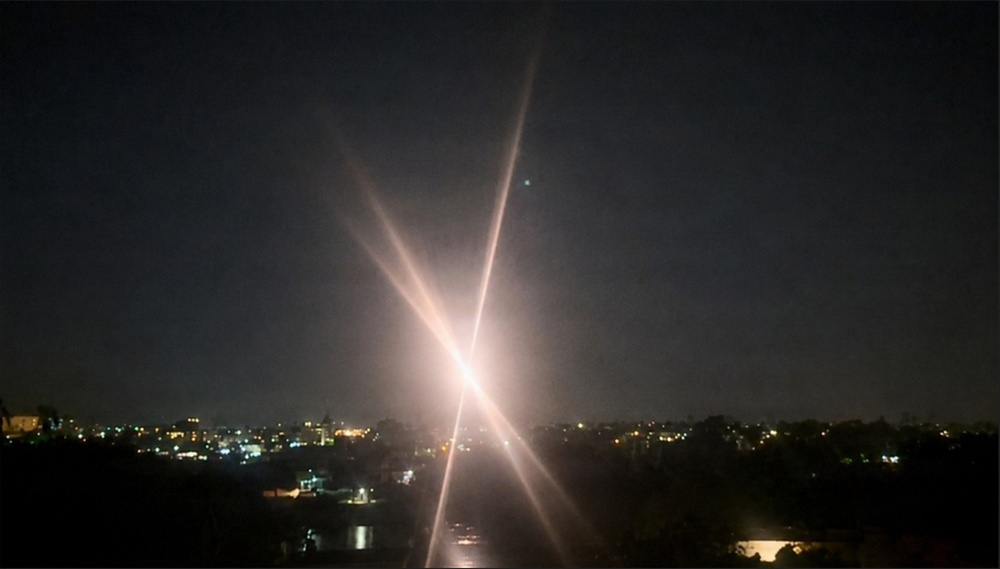
For years, the counter-drone math at the U.S.-Mexico border has been lopsided: a cartel scout quadcopter costing a few hundred dollars forces a response that can run into the tens of thousands, whether that's a jamming truck, a net gun, or in the most extreme cases a missile-armed interceptor. Joint Task Force – Southern Border says it has now flipped that equation, at least for one stretch of the Rio Grande Valley, with a directed-energy weapon that costs about $3 to fire.
According to an operational update released by U.S. Northern Command on September 4, the system — a 20kW-class high-energy laser called AMP-HEL, mounted on a GM Defense Infantry Squad Vehicle — has destroyed 11 cartel-linked drones in its first 10 days of use over the Rio Grande Valley. NORTHCOM says drone activity in that sector has dropped by roughly 75% since the laser began shooting down aircraft on August 25.
The figures were first reported by KWTX and Dallas Express, both citing the NORTHCOM release as their source, and they land in the middle of a broader counter-UAS campaign that the command says has defeated more than 300 drones along the border in 2026, over 100 of them in August alone.
What AMP-HEL actually is
AMP-HEL — short for Army Multipurpose High-Energy Laser — is a 20-kilowatt-class laser weapon built around AeroVironment's LOCUST laser and adapted by the Army for vehicle-mounted use. The unit deployed to the border rides on a GM Defense Infantry Squad Vehicle, the light tactical buggy the Army has been fielding to infantry brigade combat teams, giving the laser enough mobility to reposition along the border's patrol roads rather than sitting fixed at a single overwatch point.
NORTHCOM and the outlets covering the deployment put the unit cost at $17.4 million to $25 million — a substantial sum, but one the Army is framing against the cost of the alternative. A single engagement, once the system is fielded, runs about $3 in electricity and consumables. Compare that to a Coyote or similar kinetic interceptor, which can run into the tens of thousands of dollars per shot, or a missile-based counter-UAS round, which can cost millions. For a threat picture that NORTHCOM's 2024 congressional testimony put at roughly 1,000 drone incursions a month along the southern border, the per-shot cost difference compounds fast.
Timeline: from an accidental self-inflicted incident to a deployed weapon
The path to AMP-HEL's border debut runs through an unusual accident. According to SOFX, the Pentagon and FAA cleared AMP-HEL-class lasers for border use in April 2026, in the aftermath of a February incident in which Customs and Border Protection accidentally destroyed one of its own drones. That mishap appears to have accelerated the push to get a purpose-built counter-drone laser — rather than jury-rigged mitigation methods — approved for operational use along the border.
AMP-HEL itself entered border operations on August 24, per Dallas Express's account of the NORTHCOM update, with the system's first confirmed kills coming August 25-26: three cartel drones downed over the Rio Grande Valley, as reported by SOFX at the time. From there, the pace accelerated. By NORTHCOM's September 4 tally, the system had downed 11 drones in roughly ten days of active use — a rate of a little more than one a day.
Maj. Gen. Curtis Taylor, commander of JTF-Southern Border, told SOFX in late August that cartels are flying drones primarily for reconnaissance in support of human-smuggling operations — scouting Border Patrol positions and movement patterns ahead of crossing attempts, rather than using the aircraft as weapons themselves. That framing matters: it casts the laser's job less as shooting down attack drones and more as blinding an adversary's overwatch capability, the same logic that has driven electronic-warfare and counter-ISR investment on conventional battlefields.
Why the numbers matter — and where they come from
The 75% drop and the 11-drones-in-10-days figure both trace back to the same document: NORTHCOM's September 4 press release/operational update, titled "Joint Task Force – Southern Border uses high-energy laser system to mitigate cartel-linked drone threats." That release is the primary source both KWTX and Dallas Express quote nearly verbatim, and it's also where NORTHCOM commander Gen. Gregory Guillot's quote on the program originates: "JTF Southern Border's combined arms approach and fusion with mission partners is delivering a new layer of homeland defense capability to counter illegal activity on the border."
Army Col. Robert Felicio and Lt. Owen Farquer are quoted in the KWTX report discussing the system's operational use, though neither outlet's reporting breaks out AMP-HEL's 11 kills against the broader 300-plus border-wide total — that larger figure covers all counter-UAS methods NORTHCOM and CBP have used in 2026, of which the laser is one relatively new tool. JTF-Southern Border, which supports CBP's counter-drone mission, currently has more than 8,000 troops spread across roughly 1,954 miles of the southern border, giving some sense of the scale AMP-HEL's early results are set against — a single vehicle-mounted laser working one sector of one river valley.
The open questions
None of the public reporting so far quantifies how many lasers are deployed, whether additional AMP-HEL units are headed to other border sectors, or how the system distinguishes cartel reconnaissance drones from hobbyist or agricultural UAS operating in the same airspace — a discrimination problem that has dogged counter-drone programs elsewhere. Nor is it clear yet whether the 75% activity drop reflects drones actually being destroyed, cartels rerouting flights around the laser's coverage area, or some combination of both. NORTHCOM's release, as relayed by KWTX and Dallas Express, doesn't break out that distinction, and no independent verification of the activity-drop figure beyond NORTHCOM's own count has surfaced yet.
Why It Matters
AMP-HEL's border deployment is a real-world data point in an argument the directed-energy community has been making for years: that lasers finally make sense against the cheap-drone threat precisely because the cost curve is inverted from missiles. A $3 shot against a few-hundred-dollar quadcopter is sustainable in a way that a five- or six-figure interceptor round against the same target never was, especially at the volume NORTHCOM describes — roughly 1,000 monthly incursions as of 2024 testimony, with 300-plus defeats already logged in 2026. If an 11-for-10-days kill rate holds up as the system scales to more of the border's nearly 2,000 miles, it would mark one of the first sustained, publicly documented combat uses of a vehicle-mounted high-energy laser against real-world targets by the U.S. military, with implications well beyond the border mission — for base defense, convoy protection, and any scenario where cheap drones are being thrown at expensive assets faster than expensive interceptors can reasonably be fired back.
Sources
- Drone activity at U.S.-Mexico border drops 75% after U.S. uses laser weapon, military says — KWTX
- Lasers, Not Missiles: Army AMP-HEL Used To Defeat 11 Border Drones — Dallas Express
- Joint Task Force – Southern Border uses high-energy laser system to mitigate cartel-linked drone threats — U.S. Northern Command
- U.S. Military Laser Shot Down Three Cartel Drones at the Border — SOFX
