
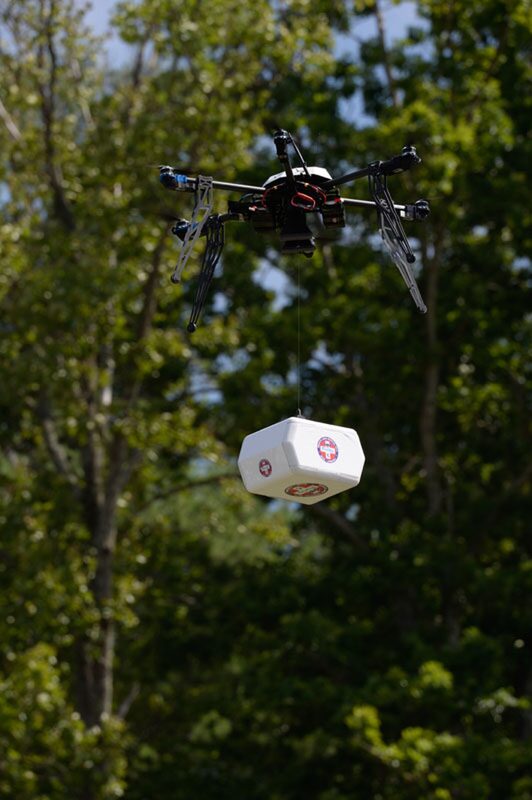
Amazon's Prime Air drones in Darlington can now reach more than ten times as many homes without flying any farther. On 10 November 2026, Amazon said the UK Civil Aviation Authority had granted it a SAIL 4 Operating Authorisation and a Flightworthiness Validation for the MK30 delivery drone. Amazon calls this the first approval of its kind for any operator in the world. Under it, the number of households eligible for drone delivery rises from about 600 to about 8,000.
The radius has not changed. As DroneXL pointed out the next day, the service still covers about 7.5 miles (12 km) around Amazon's Darlington fulfilment centre. The extra homes come from what Amazon may now fly over inside that circle, not from longer flights. The "world first" label comes from Amazon. When DroneXL checked the CAA newsroom, the regulator had not published a release of its own.
What SAIL 4 actually is
SAIL 4 is a risk level within the UK's SORA (Specific Operations Risk Assessment) framework, which the CAA uses to assess uncrewed operations that fall outside the low-risk categories. According to DroneDJ, SAIL 4 covers medium-to-high-risk operations. The higher the SAIL, the more evidence the operator has to provide about the aircraft's reliability, its safety systems and its operating procedures before the regulator signs off.
Amazon got two separate approvals: an Operating Authorisation and a Flightworthiness Validation. Amazon says the CAA assessed Prime Air's operation, aircraft, organisation and approach to risk before granting them.
Prime Air has been flying in Darlington since early 2026 under a beyond-visual-line-of-sight (BVLOS) authorisation. DroneDJ reports that this earlier permission limited operations to less populated areas. Amazon says the new approval allows it to bring the service to more densely populated communities in the area. Eligible households went up roughly thirteenfold while the radius stayed the same, which fits DroneXL's reading that the drone can now serve denser neighbourhoods that the earlier permission kept off-limits.
The aircraft behind the approval
In its announcement, Amazon pointed to the MK30's design as part of the basis for the CAA's sign-off. The company says the drone has:
- Six motors. Amazon lists these among the aircraft's redundant systems.
- A three-cell battery.
- An independent monitoring computer that oversees the main flight-control system and can hand control to a secondary system.
- Machine-learning-based detect-and-avoid for spotting and steering around obstacles.
According to DroneDJ, the service carries items weighing up to 5 lb (2.2 kg) and is included with UK Prime membership. Amazon says deliveries arrive in under two hours.
Theunis Scheepers, Director of Prime Air Europe, was quoted in Amazon's release. So was Sophie O'Sullivan of the CAA. The CAA's view therefore appears in Amazon's announcement, even though the regulator had not published its own release by 11 November.
What the announcement leaves out
DroneXL's coverage focused on what Amazon did not say. That matters because it limits how much the approval changes in practice.
Trial caps. The Darlington trial has operated under limits of 10 flights per hour and 100 deliveries per weekday. Amazon's release does not say whether those caps still apply under the SAIL 4 authorisation. If they do, the larger customer base will be sharing the same small number of flights.
Actual flight volume. Amazon has reported more than 500 flights from February through September. DroneXL calculates that this works out to roughly three flights per weekday, far below the 100-per-weekday cap. Reaching more homes is one thing. Flying meaningfully more deliveries is another, and the current numbers show the service is nowhere near its existing limits.
Expiry. The approval arrived about seven weeks before the trial permission expires on 31 December. Amazon's release gives no expiry date for the new SAIL 4 authorisation. It is therefore unclear whether this is an open-ended operating approval or another time-limited step.
The July accident. On 29 July, an MK30 came down in a garden in Beaumont Hill. The UK's Air Accidents Investigation Branch (AAIB) opened an investigation. As of 11 November, DroneXL could not find a published AAIB report. Amazon's announcement does not mention the incident. So the regulator has approved denser flights before the public has seen the accident investigators' findings on a crash involving the same aircraft type.
None of this means the approval is improper. DroneXL notes that the AAIB writes safety recommendations and cannot ground an aircraft, so its findings were never a legal precondition for the CAA's decision. Without the CAA's own statement, or at least a summary of the conditions attached to the authorisation, readers have only Amazon's account of what was approved and why.
Why It Matters
If Amazon's "world first" claim holds up, the UK has given a large commercial delivery operator a SAIL 4 approval before any other regulator has. For the wider drone industry, that matters for two reasons.
First, it shows that the UK's SORA process can approve drone delivery over more populated areas. Going from 600 to 8,000 eligible households without extending the radius shows how much of a delivery service's potential customer base depends on permission to fly over people, not on range. As DroneXL puts it, SORA makes an operator prove more as the ground below gets busier.
Second, the Darlington numbers show how far drone delivery still is from routine logistics. About three flights per weekday under a 100-per-day cap is closer to a long-running trial than a service. The SAIL 4 approval gives Amazon more customers to serve. Whether it leads to more flights depends on terms that neither Amazon nor the CAA has yet made public: the flight caps, how long the authorisation lasts, and whatever the AAIB concludes about the 29 July accident.
Other operators and regulators will be watching to see what conditions come attached to the approval. Until the CAA publishes something, or the AAIB releases its report, Amazon's milestone is genuine but only partly explained.
