
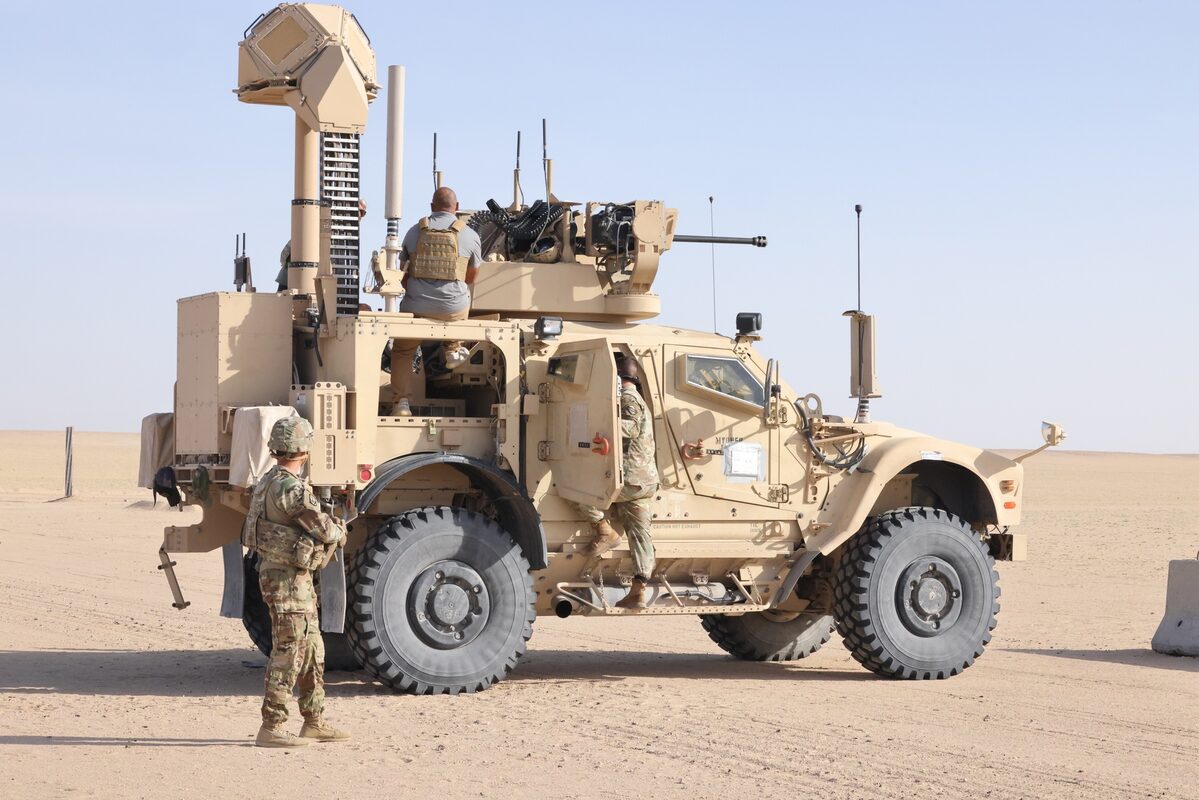
The U.S. Air Force has gone shopping for anti-aircraft guns. On Sept. 3, the Air Force Life Cycle Management Center's C3BM Directorate at Wright-Patterson Air Force Base posted a Request for Information on sam.gov for a "Ground-Based, Medium-Caliber Gun Weapon System" meant to put cheap rounds into subsonic cruise missiles and drones threatening Air Force installations. Responses are due by 5 p.m. Eastern on Oct. 9, 2026.
The RFI is short on hardware specifics and long on intent. Its stated purpose is to "identify potential industry sources capable of providing solutions for a Ground-Based, Medium-Caliber Gun Weapon System that fires affordable munitions, enables defense against air and missile threats with an initial focus on subsonic cruise missiles (CM) and Unmanned Aircraft Systems (UAS) to provide persistent defense in support of United States Air Force assets." The threat set spans the full UAS spectrum, Groups 1 through 5.
The notice is issued under the contracting office FA8612 AFLCMC C3BM C3, which sits within AFLCMC's Cyber and Networks organization, and carries a placeholder solicitation number, FA8612_. It is explicit about what it is not: this is a market survey, not a Request for Proposals, and the Air Force says it "is not seeking proposals, nor will it accept unsolicited proposals at this time." The acquisition strategy, according to the document, is "currently in development." Respondents are also told that non-government advisory and assistance contractors under nondisclosure agreements may review their submissions.
Fifteen Attributes, No Caliber
Rather than describe a gun, the RFI lays out 15 baseline attributes that industry is asked to address. Grouped by function, they sketch a fairly complete picture of what the Air Force thinks a base-defense gun has to do.
Lethality. Two separate salvo probability-of-kill figures top the list: one against cruise missiles, one against UAS Groups 1-5. The RFI specifies that salvo Pk is to be evaluated at maximum range and altitude, which is the hard case for any gun. Rounding out the lethality set are effective slant range and elevation coverage, the geometry that determines how much sky above and around a base a single mount can actually hold.
Endurance under attack. Magazine depth and raid handling appear as distinct requirements. The second is the more telling: the Air Force wants to know how a system copes with what the notice calls "saturating attacks," the mass-drone raids that have become the defining feature of the current threat environment. A gun that can kill one drone but runs dry or loses track on the tenth is not the gun the service is looking for.
Sensors and command. The RFI asks for integrated sensor capability, listing radar, electro-optical, infrared and radio-frequency options, along with command-and-control system integration and broader system interoperability "across joint networks." That last pair is unsurprising given the issuing office. C3BM is the Air Force's command, control, communications and battle management directorate. Whatever gun emerges is expected to plug into a network, not stand alone.
Economics and logistics. Cost per engagement gets its own line item, reinforcing the "affordable munitions" language in the purpose statement. Manpower, built-in test, transportability and weapon safety complete the operational picture. In a separate set of three "trade space attributes," the RFI says the system must remain "rapidly deployable, maintaining a lightweight, modular, and transportable footprint that can be swiftly projected into austere theater environments," with munitions whose "velocity, maneuverability, and terminal effects are maximized without driving the cost-per-engagement to unsustainable levels."
Multi-domain engagement. The fifteenth attribute is the vaguest and potentially the most interesting. The RFI glosses "Multi-Domain Engagement Capability" only as the ability "to counter threats across various operational environments," without saying whether that refers to a gun that can also engage surface targets or to something else entirely.
What the RFI conspicuously does not do is define "medium caliber." As TWZ observes, Army convention puts that band anywhere from 20mm through 25mm, 30x113mm, 30x173mm and 40mm. The gap between a 20mm rotary cannon and a 40mm autocannon is enormous in terms of round cost, magazine capacity, effective range and the kind of airburst or proximity-fuzed ammunition each can carry. By leaving the caliber open, the Air Force is inviting vendors to argue for their preferred point on that curve rather than pre-selecting one.
Why Guns, and Why Now
The RFI arrives in the middle of a broader Air Force push into ground-based air defense of its own bases, a mission that has traditionally belonged to the Army. TWZ frames the effort as informed by the war against Iran and by the war in Ukraine, both of which have driven home how exposed fixed airfields are to cheap, massed, low-flying threats.
The money is already moving. According to TWZ, the Air Force's fiscal year 2027 budget request seeks roughly $1.4 billion for a missile-defense variant of Air Base Air Defense Systems, or ABADS. The FY2026 request, a year earlier, sought $51.8 million in procurement for Small Unmanned Air Defense Systems, SUADS. The gun RFI sits alongside those lines rather than replacing them, filling a gap between the missile-defense end of ABADS and the small-drone end of SUADS.
Guns occupy a specific niche in a layered defense. Interceptor missiles are precise but expensive, a bad trade against drones that cost a small fraction of the interceptor: TWZ puts an Iranian Shahed-136 at $35,000 to $50,000 against roughly $5 million for a Patriot PAC-3. Directed energy promises a very low cost per shot but is a different effector class with its own constraints. A medium-caliber gun with affordable ammunition sits between the two, and the "cost per engagement" attribute makes clear the Air Force is thinking about the exchange ratio as much as the kill probability.
The inclusion of subsonic cruise missiles as a co-equal target with drones is worth noting. Group 1-5 UAS and subsonic cruise missiles share flight profiles that are, from a gun's perspective, similar problems: low, relatively slow, and often arriving in numbers. Asking for a single salvo Pk against each, evaluated at maximum range and altitude, means vendors cannot optimize for one and hand-wave the other.
What Happens Next
An RFI is a survey, and the Air Force has said so. The Oct. 9 deadline gives industry just over five weeks to describe what they can build against the 15 attributes, in no more than 10 pages, unclassified, submitted as a PDF to the contracting officers. The anticipated NAICS code is 332994, small arms, ordnance and ordnance accessories manufacturing, though respondents may argue for another. What follows is up to an acquisition strategy the service says is still being written. There is no timeline in the notice for a follow-on solicitation, no quantity, and no indication of whether the Air Force intends a competitive program of record or some faster path, though the notice does reserve the right to consider a small business set-aside based on the responses.
Interested firms should read the fine print on submission review: the notice states that non-government A&AS support staff under NDA may see what is submitted, and invites any respondent with concerns to contact the listed contracting officers. That is standard practice, but vendors bringing proprietary fire-control or ammunition designs to the table will want to calibrate what they disclose at this stage and mark it clearly, as the notice asks.
Why It Matters
For the counter-UAS community, this RFI is significant on three counts. First, it is a fresh, open solicitation from a service that has traditionally relied on the Army for ground-based air defense, which means a new customer with a new set of priorities. Second, the requirements document reads like a lessons-learned list from Ukraine and the Middle East: raid handling, magazine depth, cost per engagement, and austere-site transportability are the attributes of a system designed for the war that is actually being fought, not the one that was planned for. Third, the pairing of Group 1-5 drones with subsonic cruise missiles in a single gun requirement signals that the Air Force sees the low-and-slow threat as one continuous problem, not two.
Whether the eventual system is a 20mm rotary cannon, a 30mm autocannon with programmable airburst rounds, or something at the 40mm end, the Air Force has now told industry, in writing, that it intends to defend its own bases with guns. For a service that has long left that job to the Army, that is a notable shift, and the Oct. 9 responses will show how much of the industrial base is ready to answer.
Sources
- Ground-Based, Medium-Caliber Gun Weapon System - Request for Information (SAM.gov, posted Sept. 3, 2026)
- U.S. Air Force Seeks Anti-Aircraft Guns To Protect Its Overseas Bases (The War Zone, Sept. 4, 2026)
- USA Seeking New Ground-Based Air Defense Artillery System to Protect Air Bases Abroad (Militarnyi, Sept. 2026)
