
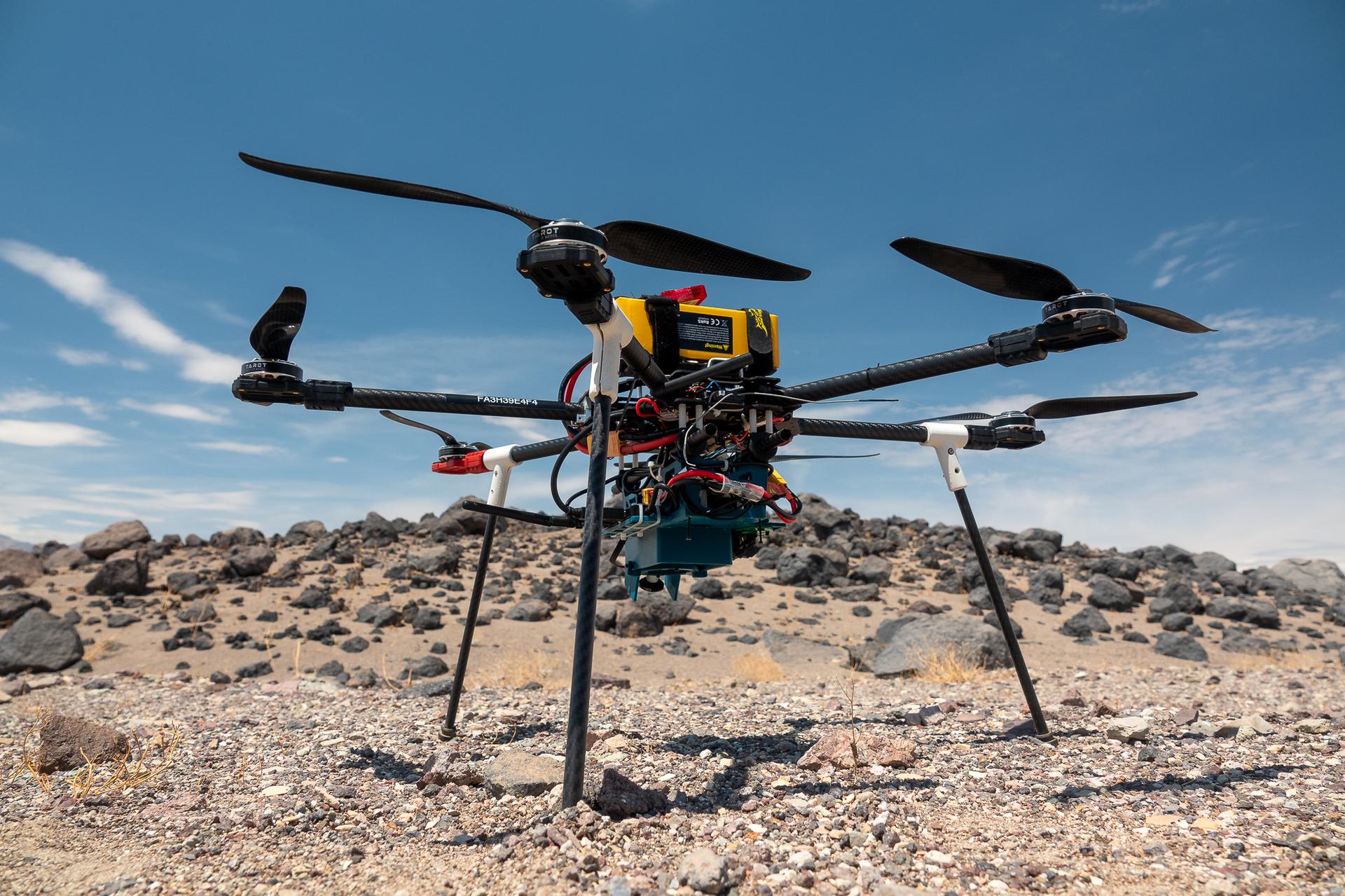
There is a principle that cuts through all the marketing around "silent" drones: "No rotary-wing aircraft can fly without displacing air." That constraint — physics, not policy — is the entire foundation of acoustic drone detection. Every spinning rotor produces a Blade Passing Frequency (BPF), a tonal signature determined by rotational speed multiplied by blade count. For commercial platforms, those fundamentals sit between 150 and 400 Hz, with harmonics climbing to 16 kHz and above and a broadband turbulence layer spanning 2 to 20 kHz. You cannot engineer that signature away without grounding the drone.
That acoustic inevitability is exactly what Ukraine turned into a nationwide surveillance network — and what the U.S. Army is now scrambling to replicate for dismounted soldiers facing Group 1 threats at the squad level.
Signal Processing Behind the Listen
Modern acoustic detection arrays do far more than record ambient sound and look for something unusual. The signal chain begins at the microphone — almost universally piezoelectric MEMS devices today, which offer IP57+ waterproofing, zero-power wake-on-sound capability enabling multi-year battery operation, signal-to-noise ratios exceeding 70 dB(A), and clip tolerance up to 130 dB. These characteristics matter in the field: an electret condenser that shorts out in rain is useless for persistent surveillance.
From the microphone array, raw audio feeds into beamforming algorithms. The workhorse here is MVDR — Minimum Variance Distortionless Response — which suppresses interfering sound sources while preserving signals arriving from a target direction. To localize a drone rather than just detect one, systems apply Time Difference of Arrival (TDOA) using Generalized Cross-Correlation with Phase Transform (GCC-PHAT), triangulating position from the slight delay in a sound reaching each microphone element. A single array yields line-of-bearing; networked arrays provide full 3D geolocation.
Array geometry matters for what data you actually get. Three-dimensional configurations — tetrahedral or hemispherical arrangements — eliminate the elevation ambiguity that plagues planar arrays. Squarehead's Discovair G2+, rated to MIL-STD-810H and deployed by the Norwegian Armed Forces, packs 128 interconnected microphone elements into a single unit and networks with additional units for omnidirectional coverage. At the other end of the cost curve, the 2026 Acta Acustica study used eight INMP441 MEMS microphones in a square planar array with 15 cm inter-element spacing — a configuration that achieved 91.6% classification accuracy but a modest detection range of 50–60 m outdoors and roughly 30 m indoors.
Classification is where AI has transformed the field. Feature extraction pipelines convert raw audio into Mel-spectrograms, MFCCs (Mel-Frequency Cepstral Coefficients), GFCCs, or wavelet transforms that capture the harmonic BPF structure unique to rotary-wing platforms. State-of-the-art classifiers use Conformer architectures — convolutional modules capturing local spectral patterns combined with self-attention mechanisms handling global temporal context — with research results reaching 98% detection accuracy. The 2020 MDPI Sensors peer-reviewed study using a 30-microphone spiral array achieved 96.3% precision overall, with its best individual result coming from a CoNN combined with Wigner-Ville spectrograms: 91% accuracy, 0.96 recall, F1-score of 0.91. Processing latency in the 2026 Acta Acustica system ran approximately 150 ms from acquisition to classification — fast enough for cueing intercept systems but not zero-latency.
Detection Ranges: Lab vs. Combat Reality
Range figures in acoustic detection marketing deserve careful parsing. The physics scales with drone size in ways that are predictable but not always convenient for small-UAS defense.
The 2020 MDPI Sensors empirical study established baseline numbers using a 30-microphone spiral array under controlled conditions: a DJI Phantom-class small drone detected at approximately 150 m; a DJI Matrice 600 at about 380 m; a large homemade octocopter at roughly 500 m. General figures from technical literature put small quadcopter detection at 200–300 m under optimal conditions, with Squarehead's testing puts a DJI Mavic Pro at about 120 m — a quieter-motor platform that drops toward the lower end of small-drone detection ranges. At the far end, Shahed-type loitering munitions and cruise missiles — louder, larger, slower — are detectable at 5–7 km.
Those ranges collapse under operational conditions. Urban background noise running 50–80 dB can mask drone signatures entirely beyond 200–300 m. Wind speeds exceeding 5 m/s cause severe distortion in acoustic measurements, with upwind signal levels dropping more than 20 dB — and high-quality windshields recover only 2–3 dB of that. Precipitation adds another 6–9 dB of masking on wet surfaces. Temperature inversions can actually improve detection by 3–4 dB through acoustic ducting, but that benefit is weather-dependent and unpredictable.
Vendors address range through networking. Hall Lidar's UDL-64 — a roughly 24-inch diameter unit deployable in one minute on battery, solar, or external power — achieves approximately 200 m standalone but approximately 500 m when networked. ZVOOK's NW0 system covers 150–450 m at 360 degrees, draws 15 W, carries an IP67 rating, and supports Ethernet, LTE, and LoRa backhaul for integration into tactical networks. Talon Avionics' SECTR interceptor pairs a 16-microphone beamforming array detecting motor signatures at up to 100 m with integrated radar extending airspace awareness to 200–1,000 m — a pairing that brings its detect-to-launch sequence under one second.
"A major advantage of our system is the fully passive acoustic detection layer." — Michael Mayer-Rosa, co-founder, Talon Avionics
Ukraine's Proof of Concept — and Its Numbers
The most significant operational validation of acoustic drone detection at scale is Ukraine's national sensor network, which as of early 2026 comprises approximately 24,000 sensors at under $500 per unit — total cost under $5 million, which is less than the price of two Patriot missiles. That cost asymmetry is the strategic argument for acoustic detection in a sentence.
The network consists of two overlapping systems. ZVOOK operates approximately 10,000 sensors with a 1.6% false positive rate — improved from an initial 50% through iterative AI training — and achieves integration-to-command time of 12 seconds. When Russia attempted signature modifications to defeat classification, the system experienced only 3% accuracy degradation. In one documented 84-drone attack scenario, ZVOOK achieved a 95% success rate in detection-to-engagement workflow. The Sky Fortress network runs approximately 14,000 sensors, tracks an estimated 20% of all airspace targets using acoustic data alone, and uses third-generation custom computing units; NATO has committed funding for 15,000 additional sensors.
COL J.J. Serowik's April 2026 Army article directly advocates adopting acoustic sensor networks on NATO's Eastern Flank Deterrence Line and in INDOPACOM. The Army C5ISR Center's January 14, 2026 RFI — issued in response to Secretary of Defense Pete Hegseth's August 2025 directive establishing Joint Interagency Task Force-401 as the Pentagon's lead for counter-small-drone capabilities — sought acoustic detection systems for dismounted soldiers to counter Group 1 (under 20 lbs) and Group 2 (21–55 lbs) UAS, with TAK/Nett Warrior integration required. Responses were due February 17, 2026.
Where Acoustic Fits in Layered C-UAS — and the Quiet-Drone Problem
Acoustic sensors occupy a specific and irreplaceable niche in multi-sensor architectures. They fill the critical gap for RF-silent "dark" drones — platforms that carry no radio emissions and present minimal radar cross-section — which neither RF detection nor most radar can reliably catch. Passive omnidirectional coverage enables acoustic arrays to serve as the initial cue in a slew-to-cue workflow, directing EO/IR cameras to sectors of interest without requiring the cameras to scan continuously. Under the NATO SAPIENT protocol — an open architecture for autonomous sensor decision-making and network-wide correlation — over 70 C-UAS systems demonstrated interoperability at NATO TIE23 exercises. Acoustic detection achieves 96%+ accuracy in multi-sensor fusion architectures even when individual sensor performance degrades.
The threat is not standing still. The Israeli Aerosol G2 produces only 14.9 dB at 1 km — roughly 10–15 dB quieter than competing platforms — and effectively operates below rural nighttime ambient noise levels of approximately 35 dB, defeating acoustic-only detection at operational ranges. Toroidal propellers eliminate tip vortices and reduce noise approximately 20 dB relative to conventional designs. "Break50Tip90" blades achieve a 74.6% perceived sound reduction with a 5.2% efficiency improvement. Serrated trailing edges deliver 5.5 dB noise reduction, and simulations suggest serration-finlet combinations could reach 20 dB.
Distributed Acoustic Sensing (DAS) — running interrogators over existing fiber-optic telecommunications infrastructure to create a virtual microphone every 10 meters across 50–100 km — represents a potential leap in passive coverage density, though institutional collaboration barriers between defense users and telecom operators remain an unsolved problem.
The drone detection market is projected to grow from $659 million in 2024 to $2.32 billion by 2029 at a 28.7% CAGR, with the broader counter-UAS market forecast to reach $20.31 billion by 2030. The Defense Innovation Unit's Low-Cost Sensing Challenge in 2025 targeted a 50–80% cost reduction in drone detection; Squarehead was among 10 finalists. The cost trajectory for acoustic hardware — MEMS microphones already commoditized, AI classification running on edge compute — points toward dense networks becoming standard infrastructure rather than premium capability. Ukraine demonstrated that a national acoustic nervous system can be built for less than a pair of air-defense interceptors. That calculus does not go away when the war does.
Sources
- Drone Warfare — Acoustic Drone Detection Systems: C-UAS Technical Overview
- U.S. Army — Listening to the Sky: Acoustic Drone Detection Systems, Ukraine, and Emerging Technologies
- DefenseScoop — Army C5ISR Center Issues RFI for Acoustic Counter-Drone Systems
- Unmanned Airspace — Ukrainian Start-Up Zvook Launches New Low-Cost C-UAS Acoustic Sensor
- United24 Media — US Firm Unveils AI-Powered SECTR Drone Interceptor That Hunts FPVs by Sound
- MDPI Sensors / PubMed Central — Drone Acoustic Signature Detection Using Spiral Microphone Array (2020)
- Acta Acustica — Acoustic Drone Detection with MEMS Microphone Array (2026)
- PR Newswire / Hall Lidar Inc. — Hall Lidar Launches Low-Cost Acoustic Sensing Drone Detection Technology
- Airsight — Drone Detection Technology: Sensor Modalities Compared
