
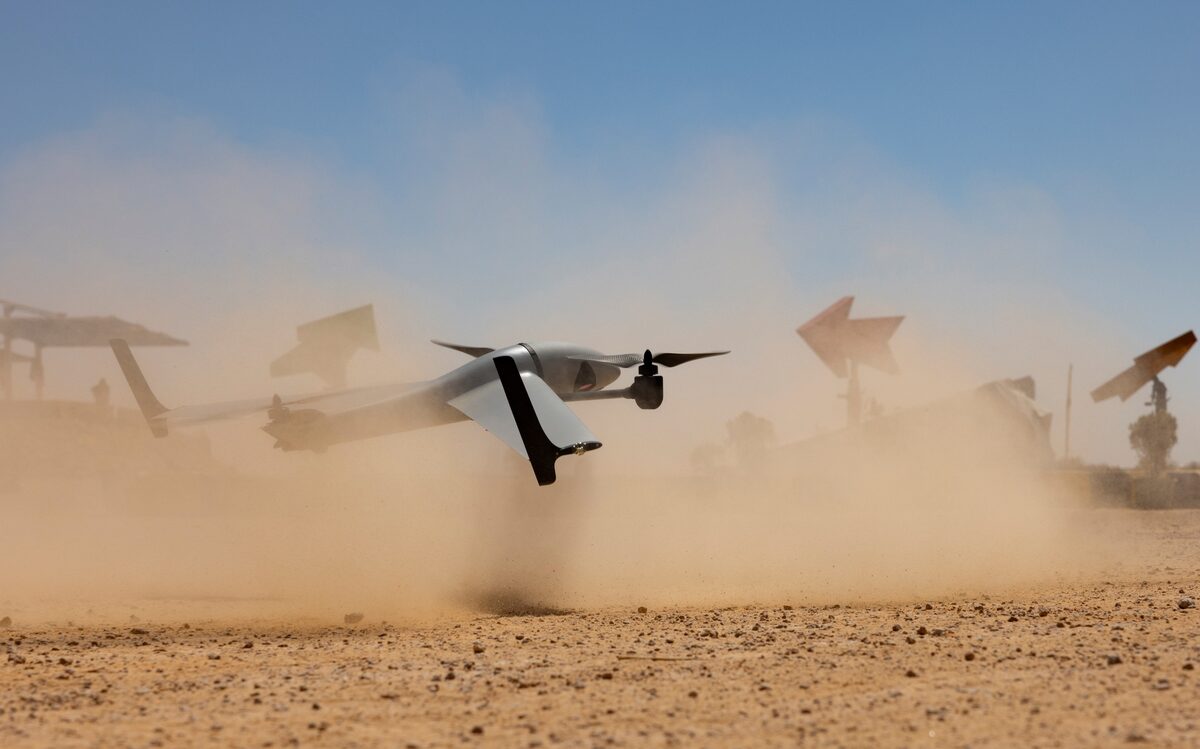
On September 17, 2026, agricultural-drone maker ABZ Innovation Kft. opened a €7 million ($8 million) extension to its production facility in Szentendre, Hungary, roughly four times the footprint of its previous site. The company is framing the expansion as a growth story: capacity rated at 2,000 heavy-duty drones a year on a single shift, climbing to 3,500 on two shifts, en route to a targeted threefold production increase in 2026 and a further doubling in 2027. But buried in the same announcement was a second, more consequential detail. ABZ's CEO, Károly Ludvigh, told Bloomberg the same day that the company will begin building drones in the United States over the course of next year.
That is not a routine market-expansion decision. It is close to a regulatory condition of ABZ's continued access to the US market at all.
A conditional pass off the Covered List
ABZ's flagship L50 spraying drone is one of a small number of foreign-made uncrewed aircraft systems holding a Department of War Conditional Approval that exempts it from the Federal Communications Commission's "Covered List" — the roster of communications and networking equipment barred from the US market under the Secure and Trusted Communications Networks Act of 2019. The exemption was formalized in FCC Public Notice DA 26-585, released June 12, 2026 by the agency's Public Safety and Homeland Security Bureau under WC Docket 18-89. Appendix B of that notice lists ABZ's L50 alongside conditionally approved systems from SiFly, Verge, Sees.ai, Air6 System, Elevon Aerial, Blueflite, Verity AG, Air VEV and Flock Safety, each carrying the same original end-of-2026 approval window. As released in June, DA 26-585 set the approval period to run only through December 31, 2026.
That alone would make ABZ's US standing provisional. What has changed it further is a July 21, 2026 National Security Determination that removed the fixed December 31 end date from ABZ's approval, and from every other Conditional Approval like it, and replaced it with an open-ended arrangement: the exemption now remains in effect for as long as the holder follows through on the onshoring plan it filed with regulators, and terminates, with the equipment restored to the Covered List, if it does not. In other words, ABZ is not just expanding into the American market on its own commercial timeline. It is executing a standing condition attached to the legal instrument that lets it sell into that market in the first place — one with no fixed deadline of its own, but with no fixed safety net either.
Why build in Hungary and the US at once
The timing raises an obvious question: why pour €7 million into a Hungarian facility while simultaneously promising a US plant within a year? The answer appears to be that the two builds serve different purposes. The Szentendre expansion, at 1,060 square meters (11,410 square feet), is aimed at satisfying demand across the more than 40 countries on six continents where ABZ's systems are already deployed, spanning four product lines: L-Series spraying drones, S-Series spreading drones, C-Series cleaning drones and M-Series cargo drones. The L-Series in particular is positioned on efficiency claims — ABZ says the sprayers can cut water usage by up to 90% and chemical inputs by up to 50% compared with conventional agricultural methods.
The US facility, by contrast, is not primarily about capacity. It is about satisfying the onshoring commitment that underpins ABZ's Covered List exemption. Without a US manufacturing presence materializing, the Conditional Approval that currently lets American farmers, agricultural cooperatives and dealers legally purchase and operate the L50 could be terminated and the L50 restored to the Covered List — not on a fixed year-end deadline, but whenever regulators conclude ABZ has stopped following through on the onshoring plan it filed.
None of this is happening from a position of financial comfort. ABZ lost 1 billion forint (roughly $3.2 million) in 2025 as it scaled up production, and the company has said break-even is still a few years out. A European drone maker running at a loss while committing to stand up a second, US-based factory within twelve months is a materially different bet than a profitable company diversifying its footprint opportunistically.
How the FCC Covered List regime works here
What is the Covered List, and why would a Hungarian company need an exemption from it? The Covered List, maintained under the 2019 Secure and Trusted Communications Networks Act, identifies communications equipment and services the FCC has determined pose a national security risk, drawing initially from concerns about Chinese-made networking gear. As drones increasingly rely on radio links, telemetry and, in many cases, cellular or satellite connectivity, uncrewed aircraft systems have been drawn into the same regulatory framework. A foreign-made UAS that would otherwise be swept up by Covered List restrictions can seek a Conditional Approval from the Department of War, which the FCC then formalizes via public notice — the mechanism that produced DA 26-585.
Why is the exemption conditioned on a US factory, and is it still time-limited? Public Notice DA 26-585 originally set ABZ's approval period to run only through December 31, 2026. A July 21, 2026 National Security Determination removed that fixed date and replaced it with an open-ended condition: the exemption now stays in effect only as long as the company follows through on the onshoring plan it filed. That structure gives regulators leverage they would not have with an unconditional, indefinite exemption — the approval can be revisited, and revoked, with the equipment restored to the Covered List, if the company does not deliver on its stated plan to manufacture domestically.
What happens if ABZ doesn't build a US plant? Per DroneXL's reporting on the July 21 notice, the consequence is specific: an approval that isn't backed by a delivered onshoring plan terminates, with the equipment restored to the Covered List. Neither DroneXL's reporting nor the underlying FCC notice describes a fixed deadline for that determination or a formal review process, but the linkage itself is established — the exemption's continuation depends on ABZ following through on US production, which Ludvigh told Bloomberg begins over the course of 2027.
Why It Matters
ABZ's situation is a preview of how "foreign drone" trade policy is likely to function going forward: not as a blanket ban, but as a conditional, revocable pass contingent on demonstrated US industrial commitment. For foreign UAS makers with any US ambitions, DA 26-585's approach signals that regulatory access can be structured to require capital investment inside the United States, not just compliance paperwork or component sourcing changes. That has direct implications for the agricultural drone sector specifically, where a handful of non-US and non-Chinese manufacturers (the Appendix B roster includes companies from multiple countries) have found a narrow legal channel into the American market that Chinese manufacturers, most notably DJI, have largely lost. Whether that channel stays open for ABZ depends on whether a company still losing millions of dollars a year can stand up a functioning US factory inside roughly the same twelve-month window it just used to open a new facility in Hungary. If it can't, one of the few conditionally-approved alternatives to Chinese-made agricultural drones in the US market could simply be pulled from Appendix B and restored to the Covered List if regulators conclude the company isn't following through on the onshoring commitment its exemption depends on.
Sources
- ABZ Opens Hungary Drone Plant, Its FCC Pass Hinges on a US Factory — DroneXL
- FCC Public Notice DA 26-585 — Conditional Approval and Exemption of Certain Uncrewed Aircraft Systems and Routers from FCC Covered List — Federal Communications Commission
- ABZ Innovation opens massive new drone production hub in Europe — DroneDJ
