
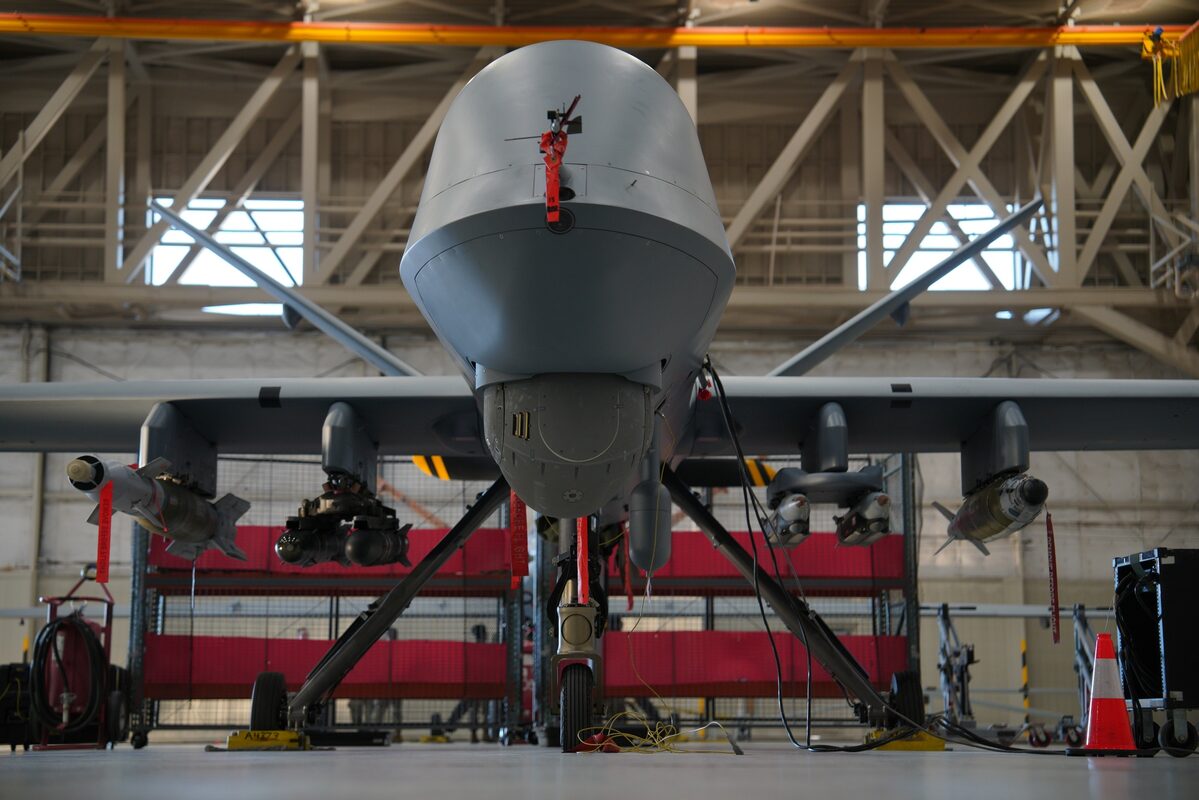
The United Kingdom is about to spend more money on drones than at any point in its military history. On June 30, 2026, Prime Minister Keir Starmer's government published its Defence Investment Plan, committing more than £5 billion — roughly $6.6 billion — over the next four years to drones and autonomous systems across the British Army, Royal Navy, and Royal Air Force. By July 3, the figure had been picked up and dissected by defense outlets across the UK and abroad, all converging on the same headline: this is the largest drone-related commitment ever made by the UK military.
The plan is not a single program but a portfolio — armed autonomous ground drones, surveillance platforms, electronic-warfare aircraft, a next-generation fighter-drone demonstrator, and a hybrid crewed/uncrewed fleet for the Royal Navy. It also stands up new institutional plumbing: an Uncrewed Systems Centre in Swindon and an industry acceleration task force meant to move drone procurement at a pace closer to that of the battlefield than the Ministry of Defence's traditional acquisition cycle.
The Strategic Rationale: Ukraine and Iran as Proof Points
UK officials did not bury the reasoning behind the number. The government's own announcement cites Ukraine's drone consumption rate — approximately 200,000 drones per month — as evidence of how central uncrewed systems have become to modern warfare. It also points to the recent Iran conflict, where drone tempo reportedly reached roughly 700 drones per day, as a second data point showing that mass, attritable autonomous systems are now a baseline expectation for any credible modern armed force, not a niche capability.
That framing matters. For years, Western militaries treated drones largely as ISR (intelligence, surveillance, reconnaissance) assets or precision strike tools flown in permissive airspace. Ukraine's war, and now the Iran conflict, have demonstrated a different model: cheap, numerous, rapidly iterated drones used at industrial scale, often as attritable one-way or reusable systems rather than exquisite, expensive platforms. The Defence Investment Plan is the UK's attempt to build that capacity into its own force structure rather than relearn the lesson mid-crisis.
What's Actually Being Funded
The headline figure breaks down into several named programs, according to UK Defence Journal's reporting on the plan's details:
- Project NYX — up to 24 armed autonomous drones for the British Army, targeted for delivery by 2030. This represents the Army's move toward organic, ground-force-controlled armed autonomy rather than relying solely on RAF or allied strike assets.
- Project Corvus — up to 24 surveillance drones, providing the Army with its own persistent overhead ISR capability separate from NYX's strike role.
- RAPSTONE — a £50 million injection aimed specifically at first-person-view (FPV) drones and counter-drone interceptor systems, the two capability areas Ukraine's battlefield has shown to be most urgently needed and most rapidly evolving.
- Storm Shroud — an uncrewed electronic-warfare drone for the RAF, entering service in 2026. Storm Shroud is designed to accompany crewed aircraft and jam or disrupt enemy air defense and communications systems, extending the survivability of manned strike packages.
- Collaborative Combat Air demonstrator — a national programme developing autonomous fighter jets, with a demonstrator due to fly by 2030, exploring how uncrewed "loyal wingman"-style aircraft can operate alongside crewed fighters.
- Royal Navy Type 91-94 platforms — a family of uncrewed maritime systems intended to operate alongside crewed vessels as part of a hybrid fleet structure, rather than replacing crewed ships outright.
Taken together, the portfolio spans all three services and both the strike and support sides of drone warfare: armed systems, ISR systems, electronic warfare, and maritime autonomy. It's a broader spread than a single flagship program, reflecting an assumption that autonomy will be woven through force structure rather than bolted on as one exquisite capability.
New Infrastructure: Swindon and an Industry Task Force
Alongside the named weapons programs, The Defense Post's coverage highlights two structural additions: an Uncrewed Systems Centre based in Swindon, and a new industry acceleration task force. Neither is a weapon system, but both address a problem that has dogged Western drone procurement broadly — the gap between how fast commercial and battlefield drone technology iterates and how slowly defense ministries traditionally buy hardware.
An acceleration task force focused on industry engagement suggests the MoD is trying to shorten the loop between UK drone manufacturers, battlefield feedback, and fielded capability — the same "reflexive control" problem Ukraine has had to solve out of necessity, updating drone designs on cycles measured in weeks rather than years.
Why It Matters
This is a rare case of a G7 military restructuring its investment priorities explicitly around lessons from an ongoing war rather than a hypothetical future conflict. The scale of the figure — more than £5 billion, described by the government itself as the largest drone commitment in UK military history — signals that London views mass-produced, attritable autonomous systems as a permanent feature of its force structure going forward, not a temporary wartime adaptation specific to Ukraine.
The program spread is also notable: rather than picking one flagship drone and scaling it, the plan funds armed ground systems (NYX), ISR (Corvus), electronic warfare (Storm Shroud), counter-drone and FPV capability (RAPSTONE), a fighter-drone demonstrator, and naval autonomy (Type 91-94) simultaneously. That mirrors how drone warfare has actually played out in Ukraine and Iran — not as a single capability gap, but as a requirement touching nearly every domain and mission set.
For the broader drone industry, the creation of a dedicated Uncrewed Systems Centre and an industry acceleration task force may matter as much as any individual program number. If the UK genuinely shortens its procurement cycle to match the iteration speed seen on modern battlefields, it could reshape how allied nations — many of which share the UK's slow, exquisite-platform procurement habits — approach drone acquisition more broadly. Whether the money translates into fielded capability on the stated timelines, particularly the 2030 target for Project NYX, will be the real test of whether this announcement marks a genuine institutional shift or simply a large number attached to a press release.