
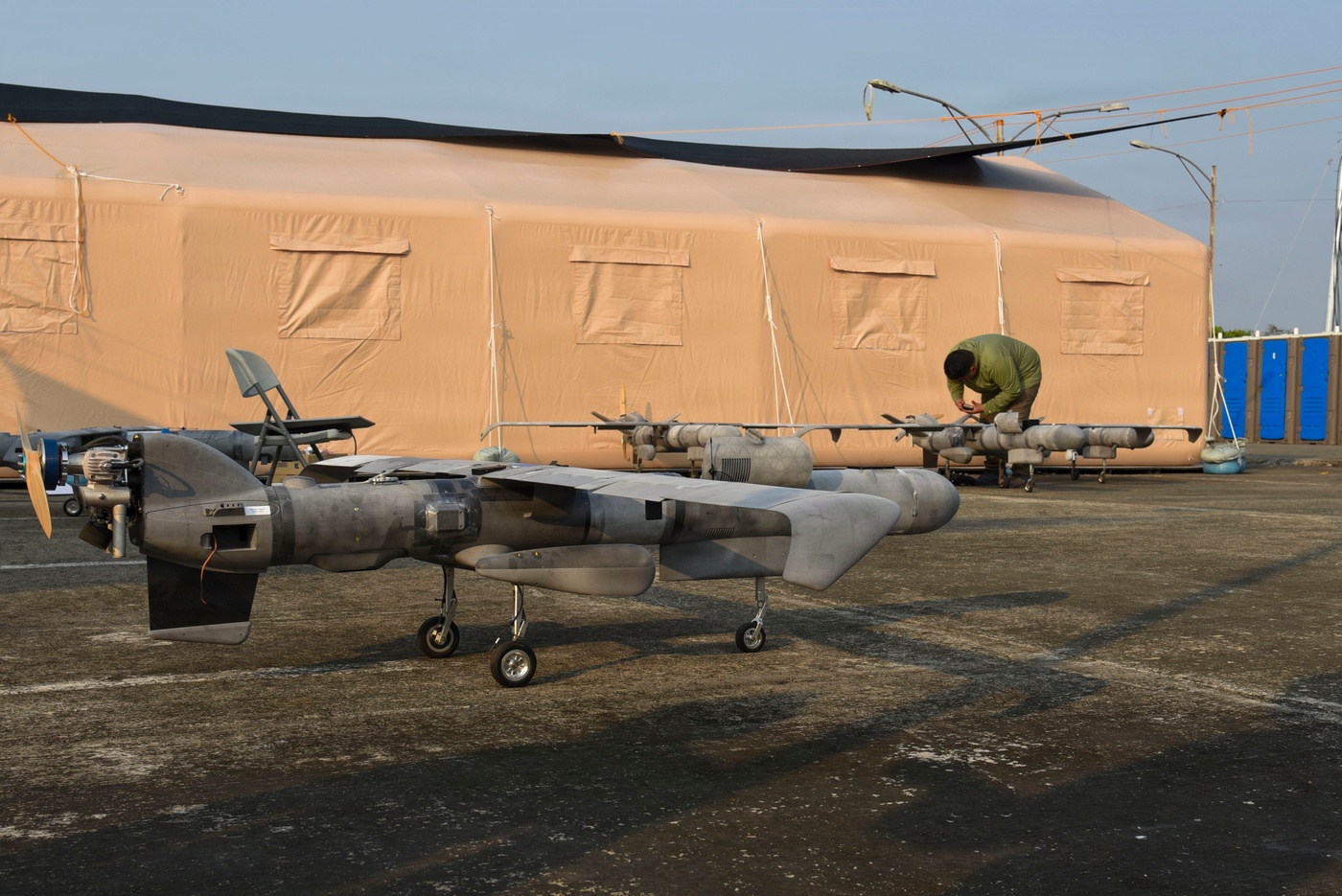
Taiwan has quietly reorganized a significant slice of its coastal defense apparatus, standing up a new Littoral Combat Command that folds anti-ship missile batteries and reconnaissance-drone assets into a single chain of command. The move, confirmed by Defense Minister Wellington Koo during a June 1 legislative hearing, formally took effect on July 1, 2026. There was no public inauguration ceremony — the command's existence surfaced through Koo's testimony rather than a ribbon-cutting, an unusual way to unveil what amounts to a new operational-level formation inside Taiwan's navy.
The command is headquartered in Huwei Township, Yunlin County, on Taiwan's western coast facing the strait, and is led by Vice Admiral Chien Shih-yuan, who was promoted into the role on June 24. President Lai Ching-te is expected to appear at a later ceremony tied to the unit, according to reporting from the Taiwan Security Monitor at George Mason University's Schar School.
What Got Merged
The new command absorbs two previously separate elements of Taiwan's navy. The first is the Hai Feng Group, the service's shore-based anti-ship missile force, which fields Hsiung Feng II, Hsiung Feng III, Hsiung Feng IIB and Hsiung Feng III-ER missiles alongside U.S.-supplied Harpoon Block II launchers. Taiwan currently has 32 Harpoon Block II launchers carrying a combined 128 missiles, with total anti-ship missile inventory expected to exceed 1,400 rounds once outstanding deliveries are complete.
The second is the Ocean Surveillance and Reconnaissance Command, which brings coastal radar networks and reconnaissance drone assets under the same roof as the missile batteries. Notably excluded from the reorganization is Taiwan's 131st missile-boat fleet, the fast-attack craft flotilla that will continue operating as a separate formation.
By putting missile fires, radar cueing and reconnaissance drones under one commander, Taiwan is effectively building a single kill chain for the strait's most contested waters — sensors that detect and track, and shooters that can be handed targets, without routing decisions through separate service silos.
The "Hellscape" Connection
The restructuring is widely read as an institutional step toward operationalizing Taiwan's so-called "Hellscape" concept — a strategy built around using large numbers of drones and uncrewed systems to slow, confuse and attrite a Chinese invasion fleet as it approaches the island. Bryce Barros, an associate fellow at GLOBSEC based in Taipei, told Domino Theory that the new command is operationally significant because it appears to take the "Hellscape" strategy into consideration, giving Taiwan a dedicated headquarters responsible for fusing the reconnaissance-drone and missile pieces that concept depends on rather than leaving them scattered across separate commands.
Ukrainian defense outlet Militarnyi, in its own coverage of the reorganization, framed the move as part of a broader fortification of Taiwan's shores, corroborating both the Harpoon missile buildup and the creation of the unified command structure as concrete steps in that direction.
The Funding Gap
The command's stand-up, however, arrives with an unresolved problem: the strike and reconnaissance drones it is meant to operate were left unfunded after opposition-led budget cuts in Taiwan's legislature. That leaves a command explicitly built around fusing missiles, radar and drones without full funding for one of its three core pillars — a gap that undercuts the premise of the reorganization even as the new headquarters becomes operational. Neither of the reports on the new command specifies a timeline for restoring that funding, and it remains a live point of friction between Taiwan's executive branch, which has pushed the "Hellscape" concept, and lawmakers controlling defense appropriations.
Why It Matters
Command structure sounds like bureaucratic housekeeping, but in a scenario where Taiwan might have minutes rather than hours to detect, identify and engage an approaching force, who controls the sensors and who controls the shooters — and how fast information moves between them — is a real operational variable. Merging Hai Feng's missile batteries with the Ocean Surveillance and Reconnaissance Command's radar and drone assets under a single admiral is Taiwan's attempt to shorten that chain and make its shore-based missile force more responsive to real-time drone and radar cueing, rather than acting on stale or relayed targeting data.
It also matters as a signal of how seriously Taipei is trying to institutionalize the "Hellscape" concept beyond talking points. Standing up a dedicated command with a named flag officer and a fixed headquarters is a heavier commitment than a doctrine paper — it creates a bureaucratic constituency that will keep pushing for the drones, sensors and munitions the concept requires. At the same time, the unfunded drone shortfall is a reminder that Taiwan's defense modernization is not solely a military-planning problem; it runs through a legislature that has repeatedly trimmed defense line items, and a command built around uncrewed systems is only as credible as the money behind the systems themselves. Watching whether that funding gap gets closed — and how quickly the new command can field the reconnaissance and strike drones it was designed around — will be a better indicator of Taiwan's "Hellscape" readiness than the reorganization announcement itself.
