
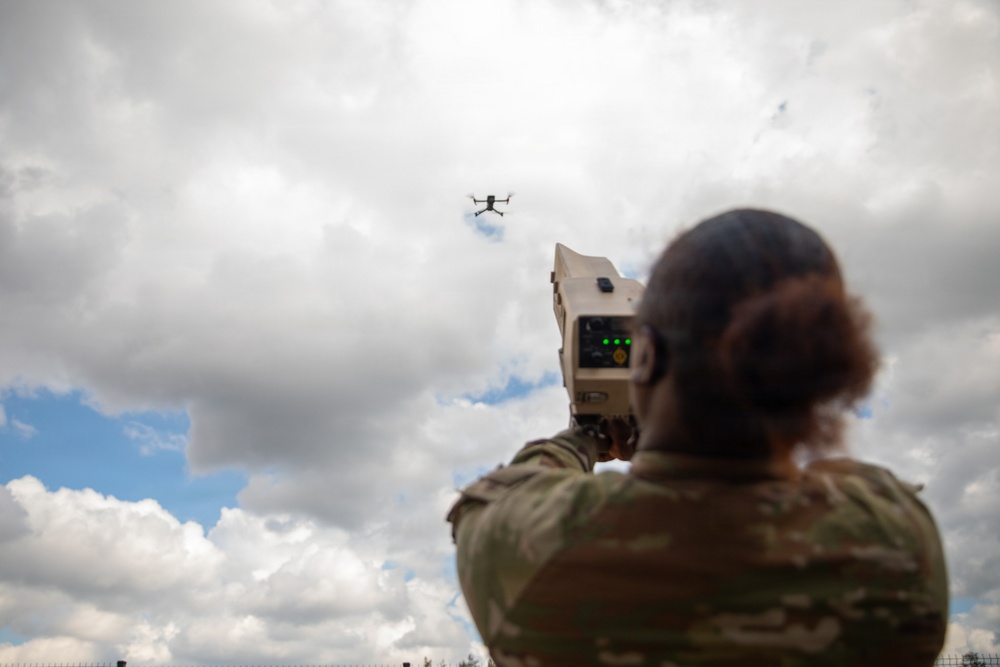
For years, the honest answer to "who can legally shoot down a drone in the United States?" was a very short list: a handful of federal agencies, and nobody else. A city police department that watched a quadcopter loiter over a stadium, a sheriff staring at a drone dropping contraband into a prison yard, a state trooper working a Super Bowl perimeter — all of them were, strictly speaking, breaking federal law the moment they tried to jam, spoof, or knock one out of the sky. As of July 1, 2026, that answer has changed.
A joint interim final rule from the Department of Justice and the Department of Homeland Security took effect on that date, implementing the SAFER SKIES Act, enacted as part of the FY2026 National Defense Authorization Act. For the first time, it extends federal-style counter-UAS authority to state, local, tribal, territorial, and correctional (SLTT) law enforcement agencies, letting them detect, track, and mitigate drones. But the rule does not simply hand out that power. It builds a gate in front of it, and the key to the gate is a certificate issued at an FBI schoolhouse in Alabama.
What the rule actually does
The interim final rule, published in the Federal Register, establishes a two-tiered training and certification structure. The lower tier covers detection and warning — the ability to sense a drone, track it, and issue alerts. The higher tier covers mitigation — the active measures that bring a drone down or force it off course. An agency cannot mix and match on its own authority; the tier of certification determines what its officers are permitted to do.
Around those two tiers, the rule wraps a dense compliance framework. It specifies the categories of authorized counter-UAS technologies agencies may field. It requires spectrum coordination, an acknowledgment that jamming and RF-based detection do not happen in a legal vacuum and can collide with protected communications. It mandates airspace approval and real-time notification to air traffic control, so that a mitigation event over, say, a downtown event venue does not become a hazard to crewed aircraft operating nearby. And it imposes mitigation reporting and privacy protections — agencies must document when and how they act against a drone, and handle the data those systems collect under defined constraints.
In other words, the rule is less a green light than a licensing regime. It answers the "who can legally down a drone" question not with a blanket "local cops now can," but with "certified local cops, operating authorized gear, on approved airspace, with ATC in the loop, and a paper trail afterward."
The FBI schoolhouse is the chokepoint
The certification does not come from a webinar. To qualify, agencies must train at the FBI's new National Counter-UAS Training Center in Alabama. That training center is the practical chokepoint of the entire scheme: it is where SLTT officers earn the detection-and-warning or mitigation credentials that the rule requires before they can lawfully act.
It is also the gate to the money. The counter-drone effort is backed by a $500 million grant pool, of which $250 million is currently available, intended to help agencies buy and operate the authorized systems. Mandatory training at the FBI center is the prerequisite to accessing those grant funds. An agency that wants both the legal authority and the federal dollars to build a counter-UAS capability has to send its people through the schoolhouse first. No certificate, no authority, no grant.
There is a second, parallel mechanism running alongside the certification track: deputization. Reporting on the World Cup counter-drone planning describes state and local officers being deputized through the FBI's Joint Terrorism Task Forces, effectively borrowing federal authority to act. Andrew Giuliani of the White House FIFA task force and former senator Norm Coleman have both framed that deputization approach as a stopgap — a way to get boots on the ground with real authority while the broader certification-and-grant structure spins up. The interim final rule and the deputization pathway are two answers to the same problem: there is a lot of protected airspace and not nearly enough federally-cleared personnel to cover it.
Why the timing: 600 incursions and a World Cup
Rules like this usually crawl. This one moved on an operational deadline. The driver, spelled out in the Bloomberg Government reporting, is the FIFA World Cup and the airspace security problem it has created. Since mid-June, authorities have logged more than 600 drone incursions over restricted event airspace. That is not a hypothetical threat model in a slide deck; it is a running tally.
The interim final rule is explicitly written to let SLTT and corrections agencies that hold federal counter-drone authorities assist other agencies facing threats — a mutual-aid provision that matters enormously when a tournament sprawls across many jurisdictions and no single federal agency can be everywhere. The World Cup is the forcing function; the 600-plus incursions are the justification that let DOJ and DHS issue the rule as an interim final rule, effective immediately, rather than waiting out a full notice-and-comment cycle first.
The parallel fight in Congress
None of this settles the underlying legislative question. On Capitol Hill, the House Transportation and Infrastructure Committee has advanced a bipartisan bill to reauthorize and reform federal counter-UAS authorities. That legislative track runs in parallel to the DOJ/DHS rule and reflects the same tension: existing federal counter-drone authorities have been living on short-term extensions, and lawmakers are fighting over how far to expand who gets to wield them and under what oversight. The interim final rule implements the authority Congress granted through the FY2026 NDAA; the T&I bill is the ongoing argument about what the durable, long-term regime should look like. Expect the two to keep shaping each other.
Why It Matters
This is the concrete rule that changes the standard explainer answer. The generic "who can legally shoot down a drone" piece has, for years, ended with "basically, only the feds." As of July 1, that is no longer accurate: a certified state, local, tribal, territorial, or correctional agency, operating authorized technology on approved airspace with ATC notification, can now lawfully detect, track, and mitigate a drone. That is a genuine expansion of who holds one of the most consequential and legally fraught powers in the airspace.
But the design of the rule is as important as the grant of authority. By routing everything through a single FBI training center and tying both certification and $500 million in grants to it, DOJ and DHS have kept a federal hand firmly on the throttle. Local agencies get the power, but only on federal terms, with federal training, and — for the money — federal approval. The two-tier structure, spectrum coordination, ATC notification, mitigation reporting, and privacy protections are the guardrails that separate this from a free-for-all, and they are where the practical friction will live: how fast the Alabama schoolhouse can certify people, how the $250 million currently available gets distributed, and whether the deputization stopgap holds up under the strain of 600-plus incursions and counting.
For agencies weighing whether to build a counter-UAS capability, the message is unambiguous. The authority is real, the money is real, and the door to both runs through Huntsville. And because this is an interim final rule with an open comment period — FDMS Docket No. FBI-2026-0001 on the Federal eRulemaking Portal — the details are not yet locked. Anyone with a stake in how SLTT counter-drone authority is structured has a window to weigh in before it hardens into a final rule.
Sources
- Counter-UAS Authority for State, Local, Tribal, and Territorial Law Enforcement and Correctional Agencies (Federal Register)
- T&I Approves Bipartisan Bill to Reauthorize and Reform Counter-UAS Authorities (House Transportation & Infrastructure Committee)
- DHS, DOJ Issue Counter-Drone Rule as World Cup Spotlights Danger (Bloomberg Government)
- Counter-drone World Cup plans include deputization of state, local law enforcement (FedScoop)
