
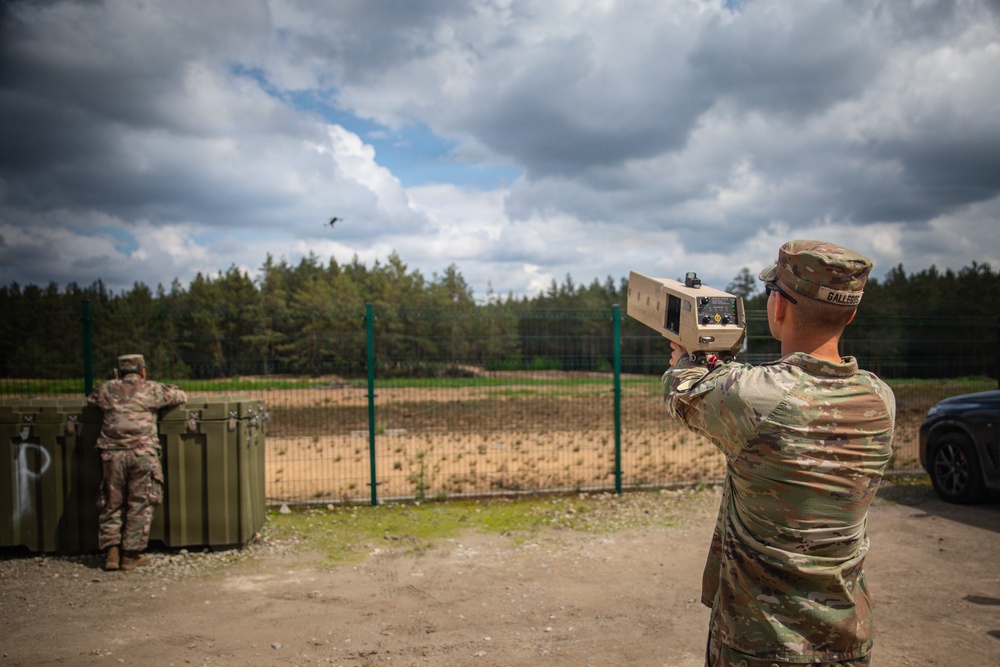
On July 9, 2026, Joint Interagency Task Force 401 quietly dropped a document that is now reshaping how the Pentagon talks about drone defense. Titled "Small Drones, Big Problems: A First Principles Approach to Countering-UAS," the handbook is not a procurement catalog or a targeting manual. It is, in effect, a doctrine reset — an attempt to talk commanders, installation planners, and interagency partners out of the instinct to treat every drone threat as a problem solved by a bigger gun.
A week after release, the handbook has become the subject of fresh analysis across the defense press, and the throughline in that coverage is consistent: the Pentagon is telling its own force that counter-UAS is not primarily a shoot-down problem. It's a systems problem, and systems problems need layered, disciplined responses — not reflexive kinetic reactions.
What JIATF-401 Actually Published
According to the Department of War's official announcement, JIATF-401 built the handbook to establish "shared understanding" of the drone threat across government, industry, and academia — a deliberately broad audience that signals the task force sees counter-UAS as a whole-of-society challenge, not just a battlefield one. The document folds in lessons drawn from recent Middle East operations and the ongoing European battlefield, giving it an evidentiary base that goes beyond tabletop theorizing.
The handbook is also not a standalone product. It arrives as the capstone of a busy 2026 for JIATF-401, which has spent the year building out a broader counter-drone ecosystem: a Counter-UAS Marketplace that reached initial operational capability in February to connect buyers with vetted technology, detection and privacy guidance issued in March to help operators navigate legal gray zones around sensing civilian airspace, and standardized C-UAS testing guidelines released the same month to bring some rigor to how counter-drone systems get evaluated before fielding. The handbook is the piece that ties the technical and procurement work to an actual way of thinking.
The Four Ps: Reframing What a "Drone Threat" Even Is
Per Task & Purpose's coverage of the handbook, its central analytical tool is a framework called the "Four Ps": person, platform, process, and payload. Rather than fixating on the aircraft alone, the model pushes analysts and commanders to break a drone incident into its component parts — who is operating it, what the airframe is and can do, how the operation is being run, and what it's actually carrying or capable of delivering.
That decomposition matters because a hobbyist quadcopter flown by a curious bystander near an installation fence line and a modified FPV racing drone flown by a trained adversary with a shaped-charge payload can look nearly identical on a radar screen or camera feed in the first few seconds. The Four Ps model is designed to force a faster, more structured sort between those cases — because the correct response to each is completely different, and a kinetic reflex applied to the wrong case wastes resources, risks collateral damage, or simply misses the actual threat.
Layered Defense, Not a Trigger Pull
Forecast International's Defense & Security Monitor, in its July 14 analysis of the document, describes the handbook's response model as "multiple, overlapping security mechanisms" rather than a single tool: capabilities that target how a drone functions, disrupt its navigation, and — only when needed — apply a hard-kill option to physically destroy it. Detection sits underneath all of it; the handbook notes that traditional radar built for large aircraft and fast missiles struggles against small, low-flying drones, so effective detection requires several complementary sensing methods working together rather than any single sensor type.
That layering is itself the argument. By treating kinetic defeat as one option among several rather than the default response, the handbook structurally discourages the shoot-first posture that has characterized a lot of ad hoc counter-drone deployment over the past several years.
Why the Data Backs the Doctrine
The handbook doesn't just assert that kinetic-only thinking is flawed — it cites numbers from recent conflicts to make the case. Two statistics stand out in the Defense & Security Monitor's account of the document.
First, Iranian Shahed-136 drones made up 66% of Iran's counterattacks during the initial phase of Operation Epic Fury — a volume that illustrates how cheap, mass-produced one-way attack drones can saturate airspace faster than point-defense kinetic systems can reasonably be expected to keep pace with, especially at cost.
Second, and perhaps more striking, is the FPV drone data out of Ukraine: first-person-view drones there have a hit rate of only 20-40%, yet they are responsible for 60-70% of Russian equipment losses and 70-80% of Russian casualties, per the Defense & Security Monitor's reporting on the handbook. That gap between hit rate and casualty share is the handbook's strongest evidence that cheap, attritable drones are reshaping lethality math on the battlefield independent of how "accurate" any single system is — and that a defense built solely around shooting down individual aircraft misses the larger pattern of saturation and attrition these systems create.
The handbook's own language captures the intended takeaway plainly: "Drones are not going anywhere; they are here to stay, and all of us must be trained and ready to deal with them, both at home and abroad."
"Not a Silver Bullet"
Task & Purpose's coverage this week zeroed in on that framing, characterizing the handbook's core message as a direct rejection of "silver bullet" thinking — the idea that any single interceptor, jammer, or gun system can solve the drone problem on its own. Instead, the outlet reports, the document frames layered defense — combining detection, non-kinetic disruption, and kinetic defeat — as the real doctrine, with the response calibrated to the threat as it's actually assessed rather than assumed.
That framing is aimed squarely at commanders and installation-security planners across the Department of War and its interagency partners, who are the primary audience tasked with translating the Four Ps and the handbook's layered-defense approach into standing procedures at bases, forward locations, and critical infrastructure sites.
Why It Matters
The handbook lands at a moment when the volume and diversity of drone threats — from swarming one-way attack munitions to hobbyist quadcopters near sensitive sites — has outpaced the ad hoc counter-drone procurement and doctrine that many units have been operating under. By codifying a shared vocabulary around the Four Ps and grounding it in hard casualty and hit-rate data from Ukraine and the Shahed-136 campaigns, JIATF-401 is trying to prevent a repeat of a well-documented failure mode: expensive, kinetic-only counter-drone systems that can't scale to the sheer volume of cheap threats now in play, while also guarding against overreaction against systems that pose no real threat. For an industry building detection, jamming, and interceptor technology, the handbook is also a signal of where DoD requirements are likely headed — toward layered systems that combine detection, disruption, and kinetic defeat rather than single-point kinetic solutions — and it follows directly from JIATF-401's year-long push on marketplace standardization and testing guidelines, suggesting the doctrine and the acquisition pipeline are now being built to reinforce each other.
Sources
- Joint Interagency Task Force 401 Publishes Counter-Drone Handbook — Department of War, July 9, 2026
- The Pentagon's New C-UAS Handbook: What's Inside and Why it Matters — Forecast International Defense & Security Monitor, July 14, 2026
- The Pentagon says drones are not a 'silver bullet' in its new handbook on fighting them — Task & Purpose