
The U.S. Marine Corps is not waiting for a competitive bidding process to get electronic-warfare jammers onto its newest amphibious vehicles. Marine Corps Systems Command has awarded Anduril Industries a sole-source contract worth $15,711,445.50 to equip Amphibious Combat Vehicles (ACVs) with Pulsar-L counter-drone jammers, according to a Marine Corps Systems Command justification document reported by The War Zone. The award notice was posted Sept. 24, 2026, and the justification cites an urgent operational need to protect the 8x8 vehicles from small, weaponized drones — a threat that has moved from theoretical to routine on modern battlefields.
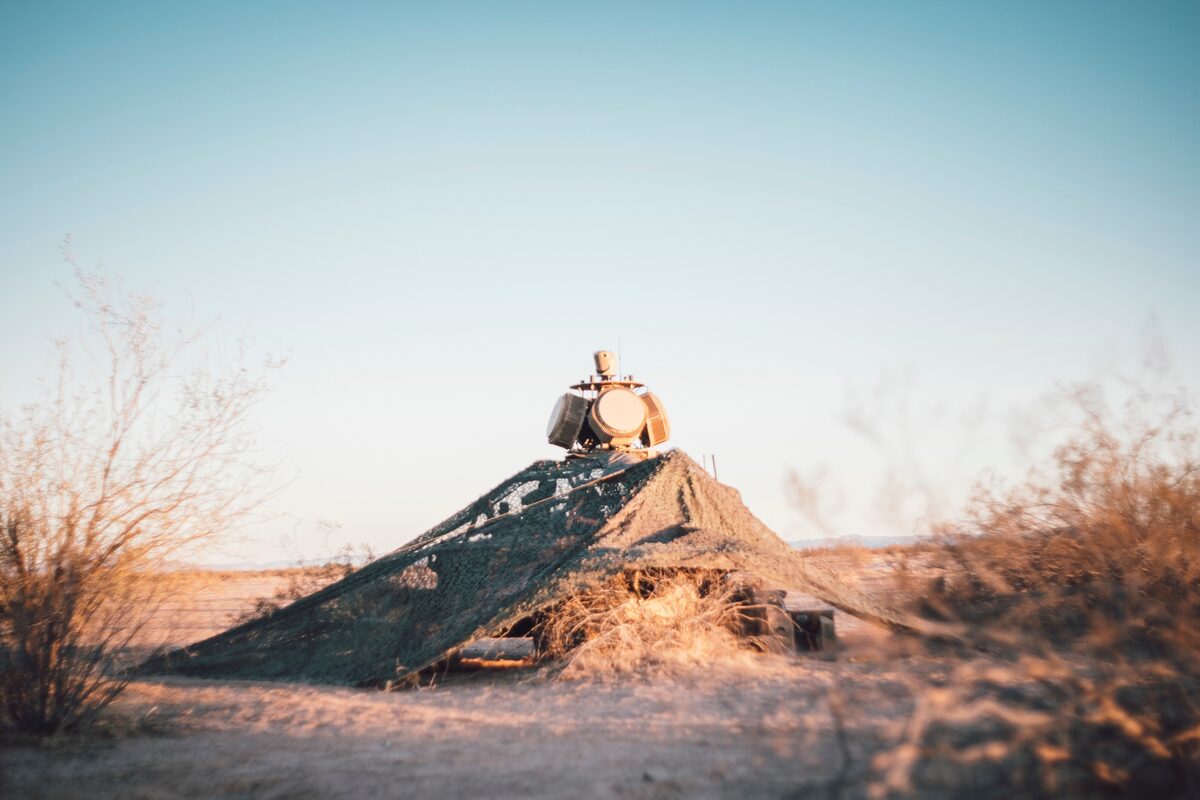
The timing is not incidental. The same week the ACV award became public, U.S. Northern Command wrapped up the fourth iteration of its Falcon Peak counter-drone exercise series at Yuma Proving Ground, Arizona, and disclosed plans for a fifth iteration that will, for the first time, test counter-drone capability in a dense urban environment. Together, the two developments sketch a service-wide and combatant-command-wide acceleration: the Pentagon is moving counter-drone technology out of pilot programs and onto fielded platforms, and out of open-desert test ranges and into the kind of cluttered, radio-frequency-noisy terrain where American troops and, per NORTHCOM's framing, American cities actually operate.
What the Contract Actually Buys
Marine Corps Systems Command announced the sole-source deal to Anduril on Sept. 24, 2026, for an unspecified number of Pulsar-L units, according to The War Zone, which reviewed the command's justification document for skipping a competitive award. The contract follows a statement of intent the command issued the previous month, indicating Marine Corps Systems Command had already settled on Anduril before the paperwork was finalized. The award notice on SAM.gov identifies the deal as sole-source, firm-fixed-price delivery order M67854-26-F-0225, executed against Anduril's indefinite-delivery, indefinite-quantity contract W9128Z-26-D-A001, with an award date of Sept. 11, 2026.
The system being installed is Pulsar-L, an omni-directional, soft-kill electronic-warfare jammer that Anduril has already fielded with U.S. Special Operations Command, according to The War Zone's Sept. 25, 2026 report by Joseph Trevithick. "Soft-kill" means the system defeats drones by severing their radio-frequency links and GPS/GNSS positioning rather than physically destroying them with a kinetic interceptor or directed-energy weapon — an approach that avoids the debris, collateral-damage and munitions-logistics problems that come with shooting drones out of the sky one at a time.
Pulsar-L is rated to counter two drone categories under the Pentagon's standard classification scheme: Group 1 systems, which weigh up to 20 pounds, fly below 1,200 feet and top out around 100 knots — the class that includes most commercial quadcopters and first-person-view attack drones — and Group 2 systems, which run 21 to 55 pounds, operate up to 3,500 feet and reach 250 knots. The jammer also provides counter-positioning, navigation and timing (counter-PNT) capability, meaning it can deny a drone's GPS lock even if its command link survives.
Why the ACV, and Why Now
The ACV is the Marine Corps' replacement for the decades-old Assault Amphibious Vehicle, designed to carry Marines from ship to shore and then operate as an armored personnel carrier ashore. As of April 2026, the Corps had fielded 150 ACV-P (personnel) variants and 21 ACV-C (command) variants, against a total program of record goal of 389 ACV-P, 33 ACV-C, 152 ACV-30 (armed with a 30mm cannon) and 34 ACV-R (recovery) vehicles, per figures cited by The War Zone. That is a substantial and growing fleet, and it is a fleet with an obvious vulnerability: an 8x8 armored vehicle moving across open beach or inland terrain is a large, slow, high-value target for a cheap quadcopter carrying a shaped charge or simply spotting for artillery. Small drones have proven, in multiple recent conflicts, capable of destroying or disabling far more expensive armored vehicles at a fraction of the cost. A sole-source, rushed acquisition — rather than a multi-year competitive program — signals that Marine Corps Systems Command judged the exposure urgent enough to skip the normal procurement timeline in favor of speed.
NORTHCOM Takes Counter-Drone Testing Into the City
While the Marine Corps was finalizing paperwork for its ACV jammers, U.S. Northern Command was running Falcon Peak 26.2 at Yuma Proving Ground — the fourth exercise in a series that began in October 2024 and, according to DefenseScoop's Sept. 25, 2026 report by Brandi Vincent, the first Falcon Peak iteration to focus specifically on defending U.S. assets, airspace and critical infrastructure from drone threats around the U.S.-Mexico border, rather than the first three iterations' focus on maturing ready-to-use defense platforms to speed services' purchasing decisions.
NORTHCOM has now confirmed a fifth Falcon Peak is coming, and its defining feature will be a first: testing counter-drone capability in a dense urban setting rather than the open desert ranges the series has used to date. Brig. Gen. Jason "Ox" Rueschhoff, NORTHCOM's director of operations, framed the shift in blunt terms: "Homeland defense is not about protecting from outside, it's also protecting inside."
That statement matters because it reframes counter-drone defense as a domestic mission, not just an expeditionary one. Desert ranges like Yuma are ideal for early-stage testing — wide sightlines, minimal RF interference, no bystanders — but they tell commanders little about how a jammer, radar or interceptor performs amid skyscrapers, reflective glass, dense Wi-Fi and cellular traffic, and civilians. Urban environments multiply the technical challenges: radio-frequency multipath and clutter degrade detection and jamming performance, and the consequences of a system that jams too broadly (disrupting civilian communications) or too narrowly (missing the drone) are far higher when the "range" is a city block.
Why It Matters
Taken together, the ACV jammer buy and the Falcon Peak urban pivot point to the same underlying shift: counter-drone defense is moving from a specialized, forward-deployed capability toward something the Pentagon expects to need everywhere, including at home. The Marine Corps' willingness to bypass competitive bidding for a $15.7 million jammer order — a relatively modest sum by defense-acquisition standards, but a telling one procedurally — suggests commanders view the small-drone threat to armored vehicles as immediate rather than hypothetical. Meanwhile, NORTHCOM's move to test in dense urban terrain acknowledges that the systems validated on open ranges may not translate directly to the environments — bases, cities, critical infrastructure — where a homeland counter-drone incident is most likely to actually occur. For an industry that has largely built and sold counter-drone systems for battlefield use, both developments point toward a widening market and a harder engineering problem: the same jammers and radars now have to work in places full of the exact RF noise, structures and civilians they were never originally tested against.
